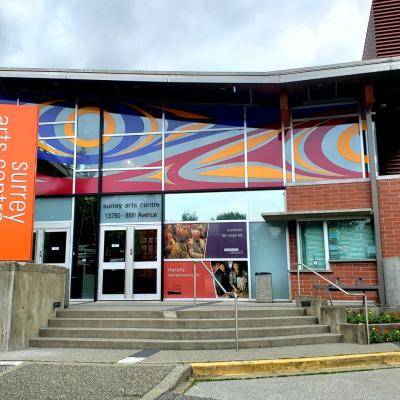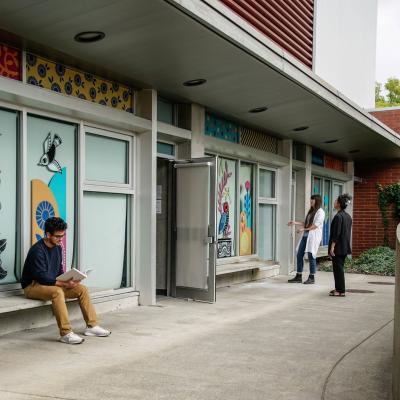
Exhibitions in the Surrey Art Gallery are drawn from and respond to predominant activity in the contemporary art community. They bring into critical context works by diverse artists with shared concerns or respond to specific issues within culture or the surrounding community.
In an effort to provide our visitors with as much detail as possible, the Gallery includes enhanced information for each exhibition in the form of printable PDFs, short Quicktime videos, and links to exhibition-related events.
Attention news media: For access to hi-resolution images, PSAs and other background information, contact Angela Cachay Dwyer, Publicist by e-mail or by telephone at 604-501-5189.

January 15 – March 18
How do artists picture the city?
A city offers both beauty and banality. It is repetitious and dynamic; it can appear to stay the same, yet change drastically over a short period of time. Beyond Vague Terrain: The City and the Serial Image shows many sides to cities, especially Metro Vancouver’s. The ambitious, and in many cases large-scale, artworks include a grid of shimmering graphite rubbings of eroded date-stamped sidewalks on Vancouver’s Westside, a 109 foot long light box presenting a panorama of Metro Vancouver as seen from a moving SkyTrain, and an interactive photographic database of every bus stop in Surrey. Through photography, painting, drawing, and video, artists have used the strategy of multiple images to create compelling ways of representing experiences of the city.
Many of the images explore urban spaces characterized by vast swaths of street intersections, industrial dead zones, and suburban sprawl. These ‘defeatured landscapes’, as they came to be known, brought international attention to Vancouver’s art scene – particularly photography – in the 1980s and early 1990s. The architect and philosopher Ignasi de Solà-Morales referred to these sorts of urban landscapes as a ‘terrain vague’. Beyond Vague Terrain brings together works from this historical period, as well as new works. In this exhibition, the multiplicity of images within a single artwork is featured, rather than the individual pictures normally associated with artistic representations of urban landscapes. These serial artworks – both photographic and non-photographic – challenge the notion of the ‘city centre’, and ask that its margins be re-imagined, just as the idea of the ‘generic city’ is challenged when a place’s specific qualities and histories are revealed.
In addition to the strong sense of realism that runs through much of the art, there is also a keen interest on the part of the artists to capture the dynamic aspects of time related to the modern city. Some artworks seek to collapse time and space. For example, Helma Sawatzky’s recombined images of a new building site in South Surrey speak to the rapid development of this part of the Lower Mainland. Other artworks use a fixed frame method to capture the shifting activities of the city and its landscape. Roy Kiyooka’s street photographs freeze moving figures and passing vehicles against storefront facades in late-1970s East Vancouver. Owen Kydd’s moving-still images of Kingsway convey a complex melancholy and rich fabric of the city, while Jeremy Herndl’s series of paintings depict an ever transforming view across a sparsely populated Whalley neighbourhood in North Surrey.
It is often claimed that in the digital era every photograph has been taken countless times over, and therefore every landscape has been documented. Can it similarly be claimed that every series of images or combination of spaces has already been pictured? Beyond Vague Terrain: The City and the Serial Image brings together a wide breadth of documentary approaches to capturing the dynamics of the city, with an emphasis on picturing its everyday features and overlooked urban forms from 1970 to the present.
The artists in the exhibition are Sylvia Grace Borda, Michael de Courcy, Chris Gergley, Jeremy Herndl, Bill Jeffries, Roy Kiyooka, Owen Kydd, Khan Lee, Helma Sawatzky, Susan Schuppli, Jeff Wall, Ian Wallace, and Neil Wedman.
January 15 - April 15 (first of three installations)
The hidden, the repressed, the lost, the invisible, and the inaudible are explored in Open Sound 2012. Three audio-based works will be presented at intervals during the year, each artwork giving expression to voiceless and sometimes intangible things. The artists (in order of appearance) are Kristen Roos, Alex Grunenfelder, and Christina Kubisch. Kristen Roos’ site-specific sound piece titled Underground uses found sounds and existing furnishings from the Surrey Arts Centre to create a resonant aural and tactile experience.
In 1917, the French composer Erik Satie composed his first piece of musique d’ameublement (furniture music), music deliberately intended to sink into the background ambiance of a room much like arrangements of furniture are meant to be conducive to comfortable conversation. Roos’ Underground operates in the foyer of the Surrey Arts Centre with this history of lobby-oriented music in mind. The work is integrated into two existing sofas that are hard-wired to emit ambient musical compositions in a way the listener can both feel and hear. The artist has installed speakers and tactile transducers into the furnishings so that they vibrate and generate low-level sound that is almost only sensible to the sitter. The sound is derived from recordings made in the basement of the Surrey Arts Centre, including the mechanical room.
Open Sound is an exhibition program developed in 2008 to support the production and presentation of audio art forms as part of contemporary art practice.

REMIXX.sur.RE
Ongoing
How do Surrey's youth see their community?
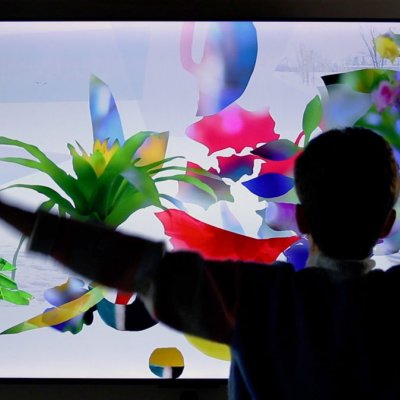
The REMIXX.sur.RE exhibit uses 700 digital photos, 60 digital video and animation clips, text in five languages and 260 audio clips created by Surrey youth. Its software engine produces hundreds of thousands of compositions from this database. These "remixes" are interactive, generated live-on the fly by the movement of visitors in the gallery. REMIXX.sur.RE personalizes every visitor's visual and audio experience. The result is an extraordinary expression of diverse youth visions of the people and places of Surrey. It is an example of youth's engagement with technology, and shows how technology is affecting perceptions of the world.
REMIXX was youth led and youth driven, supported by a team of mentors. Over 100 youth from all of Surrey's communities contributed digital content to the project. Over the summer the Gallery's TechLab became a hub of computers, conversation, emails, animating and coding, as the youth worked as artists in residence. The production team includes digital art interns Maimoona Ahmed and David Chen; mentoring artists Sylvia Grace Borda, M. Simon Levin; Leonard Paul, and Henry Tsang; program coder Jer Thorp; project coordinator, Fiona Lemon; and many youth volunteers from Surrey.
Funding for this project was made possible by: City of Surrey, ArtsNow, Spirit of BC Opportunities Program, Young Canada Works, Cultural Human Resource Council, Canadian Museums Association, The Vancouver Foundation, BC Arts Council, Canada Council for the Arts, and Surrey Art Gallery Association.
Project partners include: Surrey School Board, Surrey Art Teachers Association, and Surrey Archives.
.jpg)
World Ceramics
to August 2012
To celebrate the opening in 2011 of the new City Centre Library, Surrey Art Gallery worked with the Fraser Valley Potters Guild to present a selection of ceramic artworks that have been collected from around the world by its members. Ceramics have been produced for thousands of years and by many cultures around the globe. This display, located next to the World Languages section of the library, celebrates the diversity of styles and techniques. The works range from traditional vessels from Japan and China, to figurines from South America to contemporary pieces from Europe and North America.
Location: Surrey City Centre Library, 10350 University Drive

Electric Speed
Mona Andraos & Melissa Mongiat, Jeremy Bailey, Will Gil, Jillian McDonald, Jon Sasaki
Curated by Kate Armstrong and Malcom Levy, New Forms Media Arts Society
Electric Speed was developed for presentation as a Canadian component of the McLuhan in Europe 2011 initiative http://mcluhan2011.eu celebrating the centennial birth year of Canadian media theorist Marshall McLuhan. Shown in two parts on Surrey Urban Screen, Electric Speed is presented in conjunction with the McLuhan in Europe 2011 initiative celebrating the centennial birth year of Canadian media theorist Marshall McLuhan, and is the only Canadian presentation of this international project.
According to the late media theorist Marshall McLuhan, speed is of radical effect, having an impact on everything from how we understand notions of the centre and how we experience physical space to how our senses operate in an era of communication technology. Through speed, distance contracts, producing a simultaneous global present and the famous concept of the "global village". At the same time, our contemporary moment finds a place for the critique of speed and technology, for asking what is too fast, and where we might find modes in which to be slow.
The artists in this series have been invited to question totalizing visions of a simultaneous global culture in order to design or reinvent ideas of connection between people, systems or places. The artwork can be viewed at Surrey Urban Screen, as well as previewed on the website www.electricspeed.ca. A publication documenting this project will be launched in January 2012.
Part One: December 2, 2011 – January 15, 2012
Features the work of Melissa Mongiat & Mouna Andraos
Electric Speed Part One pdf
Part Two: January 27, 2012 – March 31, 2012
Features the work of Jon Sasaki, Jeremy Bailey, Jillian McDonald and Will Gill
Location: west wall of the Chuck Bailey Recreation Centre, 13458 - 107A Avenue, in City Centre. Surrey Urban Screen can be viewed from SkyTrain between Gateway and Surrey Central stations, and operates 30 minutes after sundown until midnight daily. www.surreyurbanscreen.ca